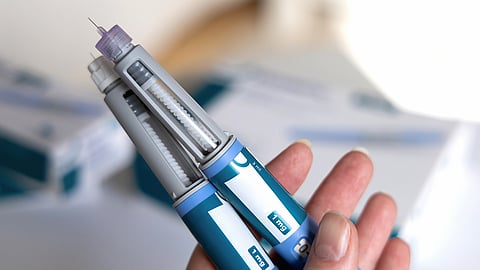

TUESDAY, Oct. 27, 2026 (HealthDay News) -- For midlife women treated for overweight or obesity, concomitant hormone therapy (HT) is associated with significantly greater weight loss with use of semaglutide, according to a study presented at the annual meeting of The Menopause Society, held from Oct. 20 to 24 in San Diego.Regina Castaneda, M.D., from the Mayo Clinic Florida in Jacksonville, and colleagues examined whether weight loss with semaglutide or tirzepatide differs for midlife women (aged 45 years or older) with a body mass index of ≥27 kg/m2 using HT (+HT) and those not using HT (noHT). Nearest-neighbor propensity score matching was performed to mitigate confounding.The semaglutide cohort included 2,379 women (793 +HT; 1,586 noHT), and the tirzepatide cohort included 1,476 women (492 +HT; 984 noHT). The researchers found that in the semaglutide cohort, HT use was associated with significantly greater total body weight loss (TBWL) beginning at nine months compared with nonuse (−9.8 versus −8.2 percent), with persistent differences seen at 12 months (−11.0 versus −9.5 percent), 15 months (−11.6 versus −9.7 percent), and last follow-up (−11.9 versus −10.9 percent). Women in the +HT group were also more likely to achieve ≥10 percent, ≥20 percent, ≥25 percent, and ≥30 percent TBWL. In the tirzepatide cohort, HT use was associated with modestly greater weight loss at three months (−6.6 versus −5.9 percent) and a higher proportion achieving ≥5 percent TBWL at last follow-up (88 versus 84 percent). Differences, however, were not significant at later timepoints or for higher weight-loss thresholds."This study highlights the importance of considering menopause-specific factors when developing personalized approaches to weight management for midlife women," Stephanie Faubion, M.D., medical director for The Menopause Society, said in a statement.Press ReleaseMore Information.Sign up for our weekly HealthDay newsletter