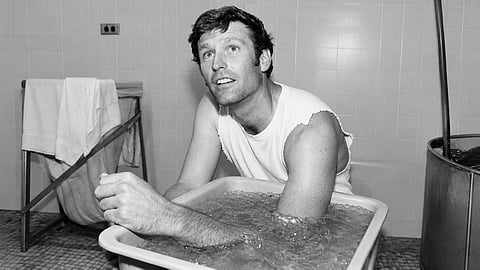

MONDAY, Aug. 31, 2026 (HealthDay News) — I woke up the other day to the news that Tommy John had died at age 83. He was a great baseball player, a brave pioneer and a good human.In June of 2006, my dad and I attended the Rickwood Classic in Birmingham, Alabama, where I was applying for work as an athletic trainer. Tommy John threw out the first pitch, and the announcer said he would be signing autographs. As an athletic trainer and baseball fan, I couldn't pass up the opportunity to get an autograph and talk to the legend.In 1974, John, then a 31-year-old pitcher for the LA Dodgers, underwent the first UCL construction by Dr. Frank Jobe. That reconstruction allowed him to continue playing for 14 more seasons. Fast forward to 2026. The American Medical Association estimates that more than 35% of Major League pitchers have since undergone that groundbreaking surgical procedure, now known as Tommy John surgery.What Is Tommy John Surgery?The Ulnar Collateral Ligament, or UCL, is a ligament on the inside of the elbow that is vital for pitching. It connects the bone in the upper arm (humerus) to the ulna (one of two lower arm bones). Tommy John surgery is a procedure that harvests a tendon — usually from the forearm, but sometimes from the hamstring in the back of the thigh — and uses it to reconstruct the UCL in the elbow. Sometimes, a donor tendon is used. The surgeon drills holes in both the humerus and the ulna, and then inserts the harvested tendon in almost a figure-eight pattern to re-create the ligament.Who Needs Tommy John Surgery?The UCL is commonly injured in baseball. That’s because as we have the ability to get our muscles bigger and stronger, the force and mechanics of pitching a baseball is hard on this ligament of the elbow. However, this injury isn’t just limited to baseball pitchers. Any athlete — professional or amateur — who needs to use force and velocity to throw or hit, or who needs to quickly slow down their arm, can have this injury. Most of the time, the pain is so intense that it limits athletic activities. Sometimes, it can even affect everyday activities in which one needs the elbow to be able to hold weight or where strong hand grip strength would be required. While most people with an injured UCL are able to function through life, they usually have numbness or tingling in their hand and pinkie that causes them to seek treatment.What Did John Go Through?So now back to 2006. That day in historic Rickwood Field, I walked down to the room where Tommy John was greeting fans, got in line and said, "I am an athletic trainer and I am so interested in your surgery. Can I get a picture with you and your scar?" He was so kind and said, "Sit down here and let’s chat." For the next 45 minutes, I sat while he signed autographs. I asked questions about his surgery, why he decided to have it, what his rehab was like and anything that I could think of, including where we were with the procedure by then, a little over 30 years after his groundbreaking surgery.I learned a lot. The decision wasn't that hard for him, he said. He knew he couldn't pitch. He trusted Dr. Jobe and knew that this was his chance, even if a small one, to continue with his career. I learned that there was no formal rehab plan. Everyone on John’s medical team knew the basics, but his actual surgery and getting back to pitching a baseball were new territory, unlike the prescribed throwing program that now exists after UCL reconstruction. So John started with range of motion exercises and got strength. Once he and his doctors knew the bone was healed, it was time to throw.What Can Patients Expect After UCL Surgery?The current recovery time for an athlete to return to competition after UCL reconstruction is 12 to 18 months. The medical team, physical therapists, athletic trainers and even most athletes are well aware of the well-researched procedures and timelines for returning after a UCL injury or reconstruction.The first couple of months are spent in full protection mode. To allow the spot where the bone was drilled to heal around the graft, the elbow is in a sling and the shoulder is kept stable. The next two months are spent working on range of motion, making sure the patient is able to move the elbow, wrist and shoulder in the distance and ways they should. After that, a few months are spent rebuilding muscles that grew weak, helping them get as close as possible to their former strength, or at least similar to the other arm. Once the arm is strong enough, the patient can begin to throw again. The Interval Throwing Program is a protocol designed by health professionals. It has strict guidelines on the distance and number of throws that should happen, with mandatory rest days built in. It’s a well-studied progression. Patients start with short toss, then move to long toss, and then they can begin pitching, if able. Depending on what sport they are returning to from this injury, their return to play may be different. Tommy John didn’t have any of that. Remember: He was Patient One. So, he did what he knew. He started with throwing a tennis ball against his garage. He used a light ball, started close, moved farther away. Then it was time for the heavier baseball. So he enlisted the help of his wife. He knew that he wouldn't throw hard if he was throwing to her. Next, he progressed to long toss — flat ground pitching, then from the mound. Just keeping on by trial and error, consulting the experts and then doing what he felt his body could handle.John told stories of coming back, the frustration, the fear, the uncertainty in how long he had, with which pitch might again be his last. That pitch turned out to be pretty far away. He pitched another 14 seasons after his return, finally retiring in 1989.As an athletic trainer, this is a core memory for me, sitting with a legend, a pioneer, hearing first-hand his experience with something that by now has become so common. John's decision to have this surgery and be the first changed the trajectory of both baseball and of future careers that would never have happened. I can't imagine the game today without this surgery and recovery.But most of all, it’s the memory of how kind he was, how open he was about his experience, how he genuinely smiled at every person who walked up to get his autograph, see his scar, shake his hand.He was a legend for his bravery, his contributions to baseball, and he was a great human to this young athletic trainer who will remember it forever. Here are three lessons from Tommy John:1. Innovation takes risk and trust.True innovation means you might fail. Someone has to be the first. And that can't be easy. Tommy John knew this surgery was a risk, but he also knew that someone had to be the first. He trusted Dr. Jobe, trusted his team and was brave enough to give it a shot. Dr. Jobe told John that there was less than a 5% chance he would pitch again. But, five was better than zero. We need to have a bit of that mentality in life too: There is no innovation without risk, and there is little innovation without trust. In true innovation, there is always a combination of both.2. He trusted the experts, trusted his body and built in boundaries.Tommy John had a team that knew the fundamentals of rehab. But that exact rehab had never been done. He consulted with the surgeon, with physical therapists, with athletic trainers, but knew that without building in boundaries, he wouldn't be able to hold back to the slow entry into throwing and pitching. So he built those in himself. This is true in all our walks of life. Consult the experts, trust your instinct and your experience, and then build in benchmarks and boundaries to prevent overconfidence.3. When you are a trailblazer, don't forget your humanity.Tommy John could have gone many ways. He chose openness, he chose to lift as he rose. If you talked to Dr. Jobe, he gave all his credit to his patients. When you talked to Tommy John, he gave all the credit to Dr. Jobe. In the end, each had care and concern for the other — a willingness to get it right rather than be right, and then, the humanity to pass it on. Tommy John could have signed something, taken my picture and sent me on my way. But he told stories, he shared the vulnerabilities, the realities and the humor. We have to keep that humanity when we have success in life and business. To remember that it is always bigger than one person, and that we can always share and spread credit.References:Tommy John Surgery (UCL Surgery)Sports Return-To-Play ProtocolsAbout the writerKatie Beach is a former certified athletic trainer whose career included eight years working with women’s soccer, softball and lacrosse programs at Virginia Polytechnic and State University. She is the founder of Mojo Leadership Group and is a speaker, facilitator and leadership coach in Salem, Virginia, where she works with managers, leaders and teams on how to bring the lessons from the sidelines of sports to their businesses. Beach shares these lessons in her weekly newsletter, The Sideline Seat, where a version of this primer was previously posted. .Sign up for our weekly HealthDay newsletter