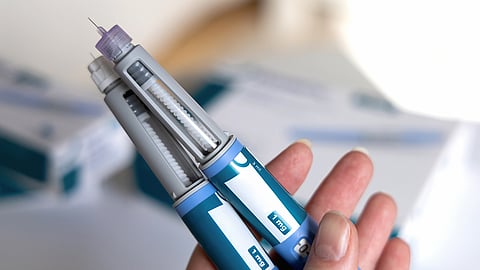

Key TakeawaysWeight-loss drugs can help families save money on groceriesFood bills drop by more than 5% among households in which someone’s taking a GLP-1 drugPeople especially spend less on processed foods and fast food.MONDAY, Jan. 5, 2026 (HealthDay News) — There’s a hidden economic benefit to weight-loss drugs like Ozempic and Zepbound, researchers say: Lower grocery bills for families.Food expenses decline within six months among households with at least one person taking a GLP-1 drug, a new study says.Spending especially drops on less-healthy options, with families forking out less cash for processed foods or fast-food meals.“The data show clear changes in food spending following adoption” of GLP-1 drugs, lead researcher Sylvia Hristakeva said in a news release. She’s an assistant professor of marketing at Cornell University in Ithaca, N.Y.About 16% of U.S. households have at least one person taking a GLP-1 drug, researchers said in background notes.These findings could be good news for those families, given the steady increase in food prices over the past year.For the study, researchers analyzed data from a market research firm that maintains a representative panel of 150,000 U.S. households. The data included the families’ food purchases and noted if someone in the household used GLP-1 drugs.Glucagon-like peptide-1 (GLP-1) drugs mimic the GLP-1 hormone, which helps control insulin and blood sugar levels, decreases appetite and slows digestion of food. The most well-known are semaglutide (Ozempic, Wegovy) and tirzepatide (Mounjaro, Zepbound).Results showed that grocery spending dropped by more than 5% within six months of a family member starting on a GLP-1 drug.That amounts to an average $390 less spent on food purchases per household, out of an average annual grocery bill around $7,400.The drop was even steeper — more than 8% — among higher-income households.Spending on calorie-dense processed foods declined the most, researchers found. Families spent about 10% less on chips and savory snacks, nearly 9% less on sweet bakery products and nearly 7% less on cookies.Families also visited fast-food joints and coffee shops more infrequently, with spending at those businesses declining by about 8%.Only four food categories showed spending increases — nutrition bars, fresh fruit, meat snacks and yogurt.“The main pattern is a reduction in overall food purchases,” Hristakeva said. “Only a small number of categories show increases, and those increases are modest relative to the overall decline.”However, this decline in food spending appears to evaporate if a person stops taking their GLP-1 drug or adopts a lower maintenance dose, researchers said.“After discontinuation, the effects become smaller and harder to distinguish from pre-adoption spending patterns,” Hristakeva said.The new study appears in the Journal of Marketing Research.More informationThe Cleveland Clinic has more on GLP-1 drugs.SOURCES: Cornell University, news release, Dec. 22, 2025; Journal of Marketing Research, Dec. 16, 2025 .What This Means For YouGLP-1 drugs might help families save some money on food..Sign up for our weekly HealthDay newsletter