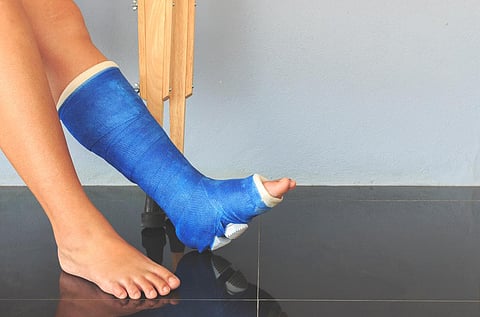

TUESDAY, Jan. 20, 2026 (HealthDay News) -- For treatment of unimalleolar Weber B ankle fractures with a congruent mortise on initial radiography but deemed unstable, cast immobilization is noninferior to surgery, according to a study published online Jan. 14 in The BMJ.Tero Kortekangas, M.D., Ph.D., from Oulu University Hospital in Finland, and colleagues conducted a randomized, noninferiority trial to compare cast immobilization to surgery using open reduction and internal plate fixation for unimalleolar Weber B ankle fractures with a congruent but unstable ankle mortise. A total of 840 skeletally mature patients age 16 years and older with an isolated Weber B fibula fracture were assessed for fracture instability. After exclusion of those with stable fracture, mortise incongruency, or fracture dislocation, 126 with a congruent but unstable ankle mortise were randomly assigned to receive conventional cast immobilization for six weeks or surgical treatment with open reduction and internal plate fixation followed by cast immobilization for six weeks (62 and 64 patients, respectively).In the primary intention-to-treat analysis of 121 participants with two-year follow-up, the researchers found that the mean Olerud-Molander Ankle Scores were 89 and 87 in the cast immobilization group and surgery group, respectively (mean difference, 1.3 points; 95 percent confidence interval, −4.8 to 7.3). There were no significant differences observed in any of the secondary outcomes (i.e., ankle function, pain, health-related quality of life, ankle range of motion, and radiographic outcome). Radiologic evidence of nonunion was seen for one participant in each group."This lends further support to the evolving concept that the treatment of ankle fractures should focus on obtaining and maintaining a congruent ankle mortise until fracture union, using the most conservative means possible," the authors write.Abstract/Full TextEditorial.Sign up for our weekly HealthDay newsletter